
PHOENIX, Ariz., November 1, 2026. He sent LinkedIn a valid U.S. passport. LinkedIn denied his appeal for "lack of legitimate identification" and has never said why it locked the account. It has not deleted the account after six written requests. Today TelicX, the Phoenix maker of A.D.A.M., an AI advisor for car dealerships, called on everyone locked out of LinkedIn to come forward. The call follows three and a half months, seven support cases and 41 emails from TelicX chief executive Brian Schwelling, who is still locked out.
What happened
According to Mr. Schwelling's correspondence with LinkedIn support:
- July 2026. LinkedIn verified his identity and told him he had more than one account, which its rules do not allow. He asked LinkedIn to close the extra account and keep one for himself and TelicX.
- August 3, 2026. His account was restricted. He wrote that day that it had not happened "until I tried spending money with you." He verified his identity again with a government ID, and on August 6 LinkedIn wrote, "We've verified your information and the restriction has been removed." It took four days. The only explanation offered was possible unauthorized access, which he told LinkedIn had not happened. By then, he wrote, clients were asking why he had blocked them.
- October 20, 2026. He published an article, went to pay to promote it, and was locked out again. His messages that day went to a LinkedIn support address that answered that it was "no longer active or monitored."
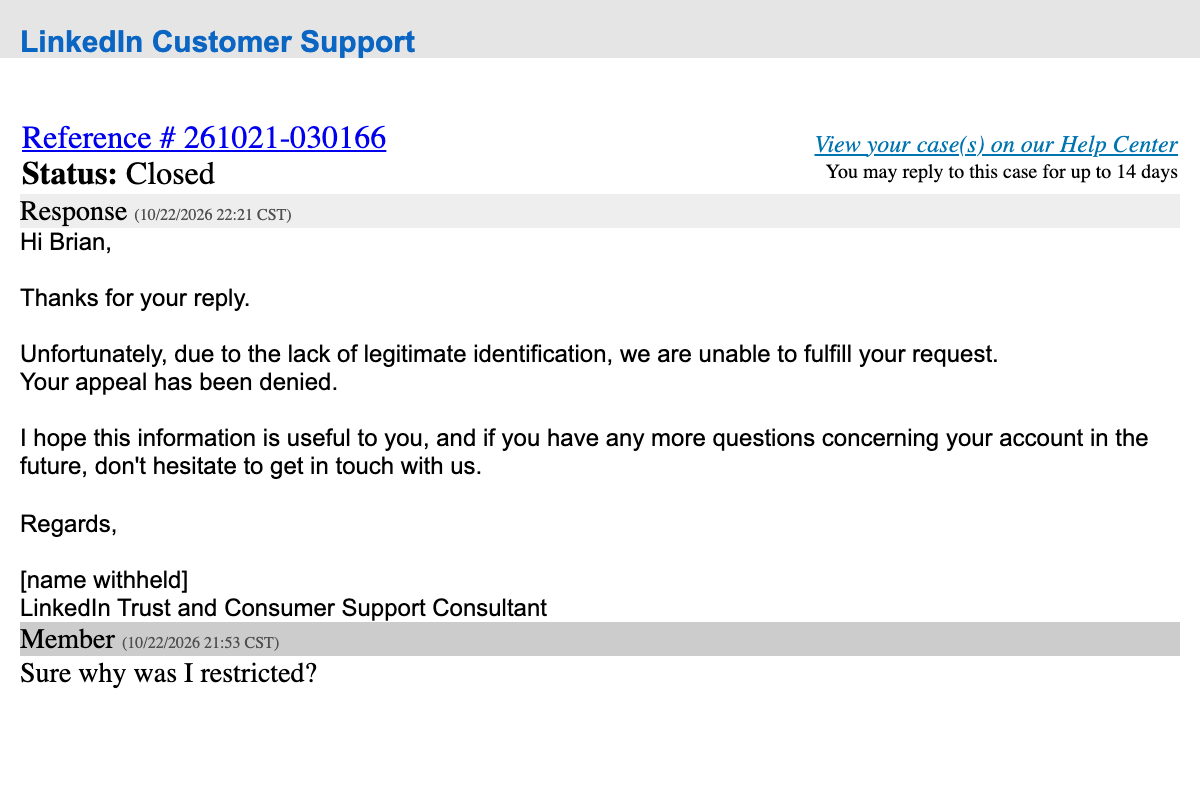
- October 21 to 23. LinkedIn asked him, again and again, to upload a government ID. He did, including a valid U.S. passport. On October 22, LinkedIn answered: "Unfortunately, due to the lack of legitimate identification, we are unable to fulfill your request. Your appeal has been denied." He asked the same day why he had been restricted. He has never been told.
- The money. By his count, TelicX had spent close to $400 on LinkedIn advertising in the prior 30 days, advertising it could no longer use. He asked LinkedIn for a refund and an explanation of the billing, and when neither came, disputed the October charges with his card company.
- October 26. LinkedIn asked him to upload a second government ID.
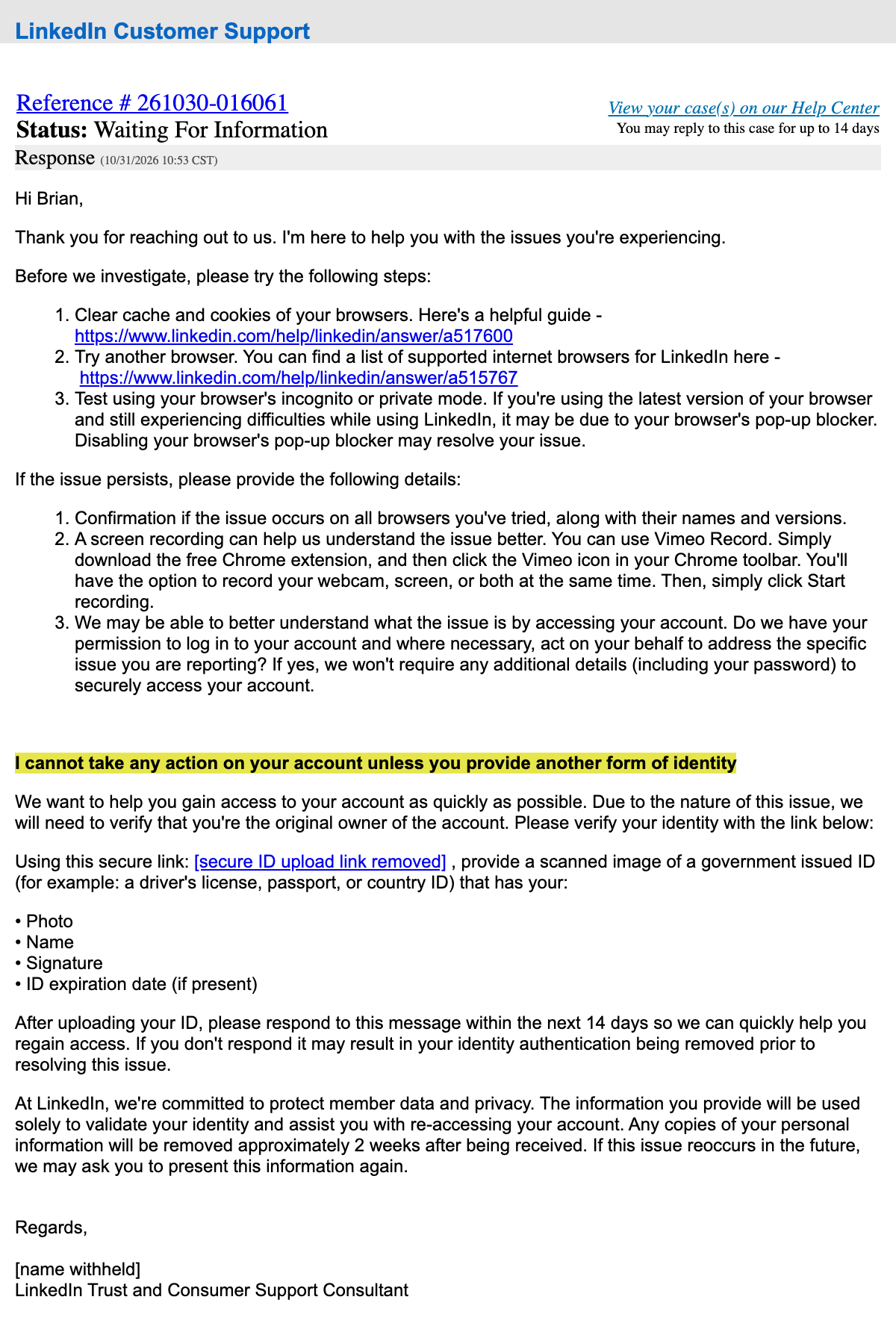
- October 30 and 31. He asked LinkedIn in writing, six times, to delete the account and to stop holding and charging his payment card. LinkedIn answered by placing a "temporary restriction" on the account while it investigated, and then by suggesting he clear his browser's cache and cookies and try another browser. As of November 1, the account has not been deleted.
"LinkedIn is where a young company introduces itself to its industry. Twice, right as we paid LinkedIn to promote our work, our account was switched off, and no one would tell us why," said Brian Schwelling, chief executive of TelicX. "I sent my passport. I was told it wasn't legitimate identification. Then they asked me for permission to go into the account. If my word is good enough for that, it should have been good enough to verify me. I've asked them to close the account and delete my card, and the answer is to clear my cookies. We don't believe we are alone, and we want to hear from everyone this has happened to."
TelicX asked LinkedIn's press team for comment on October 31, and sent the same request through Mr. Schwelling's open support case. That evening, LinkedIn's support team replied in the case, asking which browsers he had tried, for a screen recording of the ID upload, and for permission to log in to his account. LinkedIn did not comment on the release by the time of publication.
Not the first time LinkedIn has answered for how it treats members
LinkedIn has faced members, advertisers and regulators before:
- Perkins v. LinkedIn (2015). LinkedIn agreed to pay $13 million to settle a class action over its "Add Connections" feature, which sent repeated invitation emails to members' contacts. The U.S. District Court for the Northern District of California granted final approval in February 2016, and LinkedIn changed how the feature discloses and sends those emails.
- In re LinkedIn Advertising Metrics Litigation (2024). LinkedIn agreed to pay $6.625 million to settle claims by U.S. advertisers that it counted video ad views that played off screen. LinkedIn denied wrongdoing and agreed to have an outside auditor review its ad metrics for two years.
- Ireland's Data Protection Commission (2024). In October 2024, Europe's lead privacy regulator for LinkedIn fined the company €310 million over its use of members' personal data for behavioral analysis and targeted advertising, and ordered it to bring that processing into compliance. LinkedIn disagreed with the decision.
- The 2012 password breach. After about 6.5 million LinkedIn passwords surfaced online, a premium member filed a $5 million class action. The court dismissed it in 2013.
Lockouts are a known problem across social platforms
In March 2024, a bipartisan coalition of 41 state attorneys general, Arizona Attorney General Kris Mayes among them, wrote to Meta about a dramatic rise in Facebook and Instagram users who were locked out of their accounts and could reach no one for help. The attorneys general told Meta they would not serve as its customer service department. Complaints to their offices about lockouts had climbed sharply, 740 percent in Vermont alone from 2022 to 2023.
Europe gives members rights that Americans don't have
Under the European Union's Digital Services Act, a platform that restricts an account must give the member a specific statement of reasons, and must handle appeals in a timely, diligent and non-arbitrary way. A German civil rights group, the Gesellschaft für Freiheitsrechte, has filed a complaint under that law against LinkedIn on behalf of a restricted member in Dublin who was given too little information to challenge the decision. Members in the United States have no such statute behind them.
What they do have is LinkedIn's own User Agreement. For U.S. members, it provides that California law governs any dispute and that claims may be brought only in the federal or state courts of Santa Clara County, California.
The call
TelicX invites any business or individual to write to lockedout@telicx.com if they have:
- had a LinkedIn account restricted or suspended without a clear reason,
- been unable to reach a person at LinkedIn about it,
- been unable to close an account or remove a payment card, or
- lost business, clients, income or a job search because of it.
Helpful details include when the restriction began, what LinkedIn said, what it cost, and copies of correspondence. TelicX will keep every submission confidential and will not publish a name without permission.
TelicX is gathering these accounts and weighing its options. It will share what it learns.
About TelicX
TelicX builds A.D.A.M., the Adaptive Dealer Advisory Mind, an AI advisor that reads a dealership's own data across sales, inventory, acquisition, service and the financial statement and coaches every seat on what to do next. TelicX is a Baruch Kairos Group company based in Phoenix.
Sources
- Perkins v. LinkedIn Corp., No. 5:13-cv-04303 (N.D. Cal.), final approval February 16, 2016.
- In re LinkedIn Advertising Metrics Litigation, No. 5:20-cv-08324 (N.D. Cal.), settlement announced July 2024.
- Data Protection Commission (Ireland), "Irish Data Protection Commission fines LinkedIn Ireland €310 million," October 24, 2024.
- Szpyrka v. LinkedIn Corp. (N.D. Cal.), filed June 2012, dismissed March 2013.
- National Association of Attorneys General, letter of 41 attorneys general to Meta on account takeovers, March 6, 2024; Office of the Arizona Attorney General press release.
- Regulation (EU) 2022/2065 (Digital Services Act), Articles 17 and 20; Gesellschaft für Freiheitsrechte complaint against LinkedIn Ireland.
- LinkedIn User Agreement, Section 6, as published at linkedin.com/legal/user-agreement.