
If you read one thing: dealerships never had a data problem. They have a coaching problem. A.D.A.M., the Adaptive Dealer Advisory Mind, reads a store's own numbers and coaches every seat in the building on what to work first and what it is worth. It also knows what your people already know, what their pay plans are really telling them, and how each person is best reached. And it never drops the thread on a directive, because it never stops coaching until the goal is achieved. Then it coaches some more. A second system, E.V.E., guards it around the clock.
The Monday meeting
Every operator knows this meeting. Monday morning, managers in one room, and a decision gets made. Tighten the front-end discipline on the used line. Push absorption. Fix the handoff between the desk and F and I. Everyone nods. Everyone means it.
By Thursday, the decision is a memory. Not because anyone failed, but because the store got loud. The floor filled, the phones rang, the month leaned in, and the directive died the way directives always die, in the space between a decision and its execution.
Forty years on the floor taught us that this space is where dealerships lose the most money. And that no software has ever lived in it. Software reports what happened. Nobody was in the room reminding, nudging, coaching, and refusing to forget.
So we built something that lives there.
A coaching problem, not a data problem
Every franchised store in America has more data than it did five years ago. More dashboards, more logins, more reports nobody opens after the tenth. And the month did not get easier, because the missing thing was never information. It is the moment a number becomes a cause, and the cause becomes a conversation with the person who can actually change it.
That moment is coaching. It is what great operators have always done, and it is what software has never done. The talent on a dealership floor is rarely the problem. The stumbling block in front of it is. So instead of building another screen for people to check, we built a coach that checks on people.
What A.D.A.M. does all day
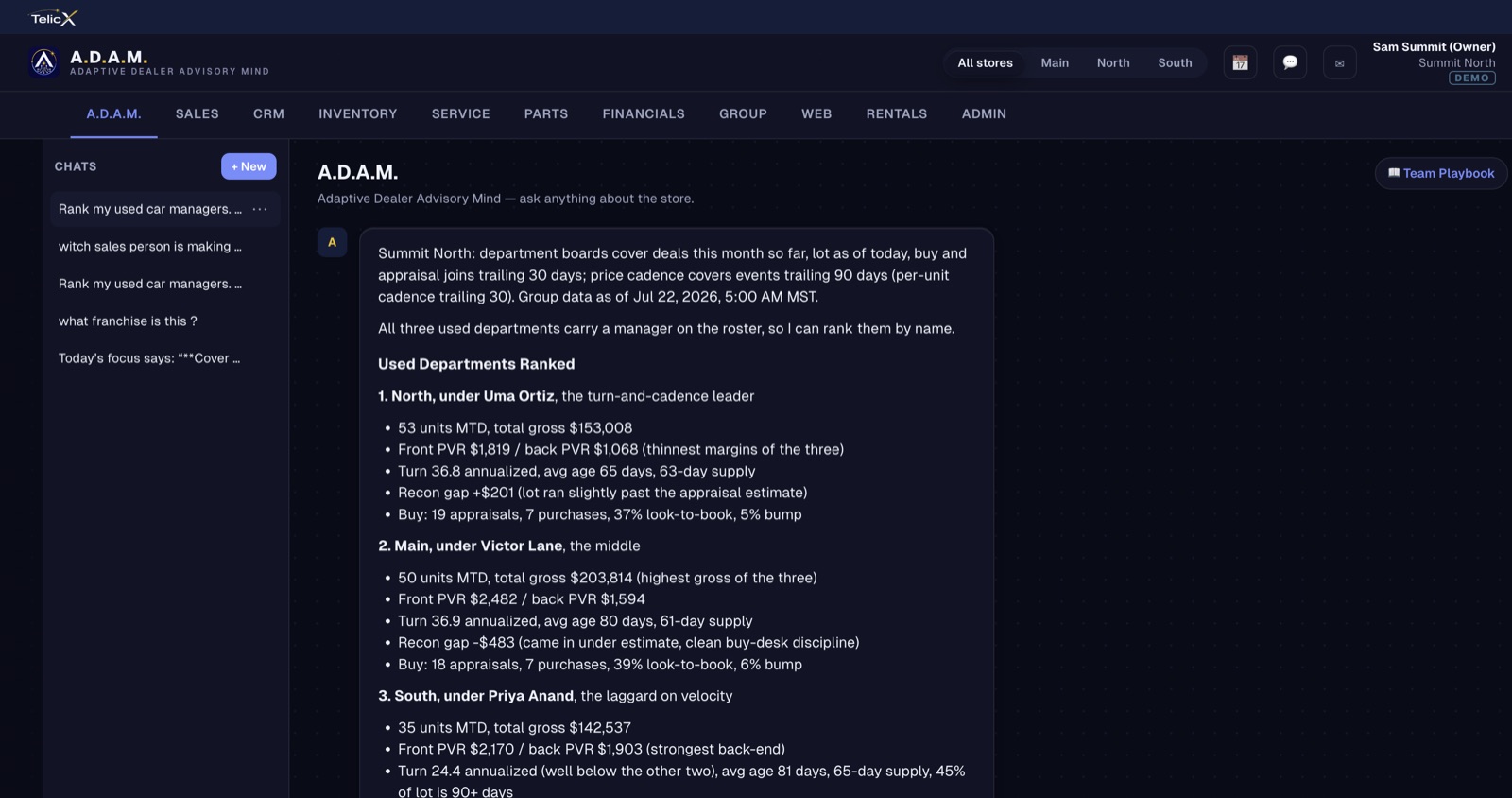
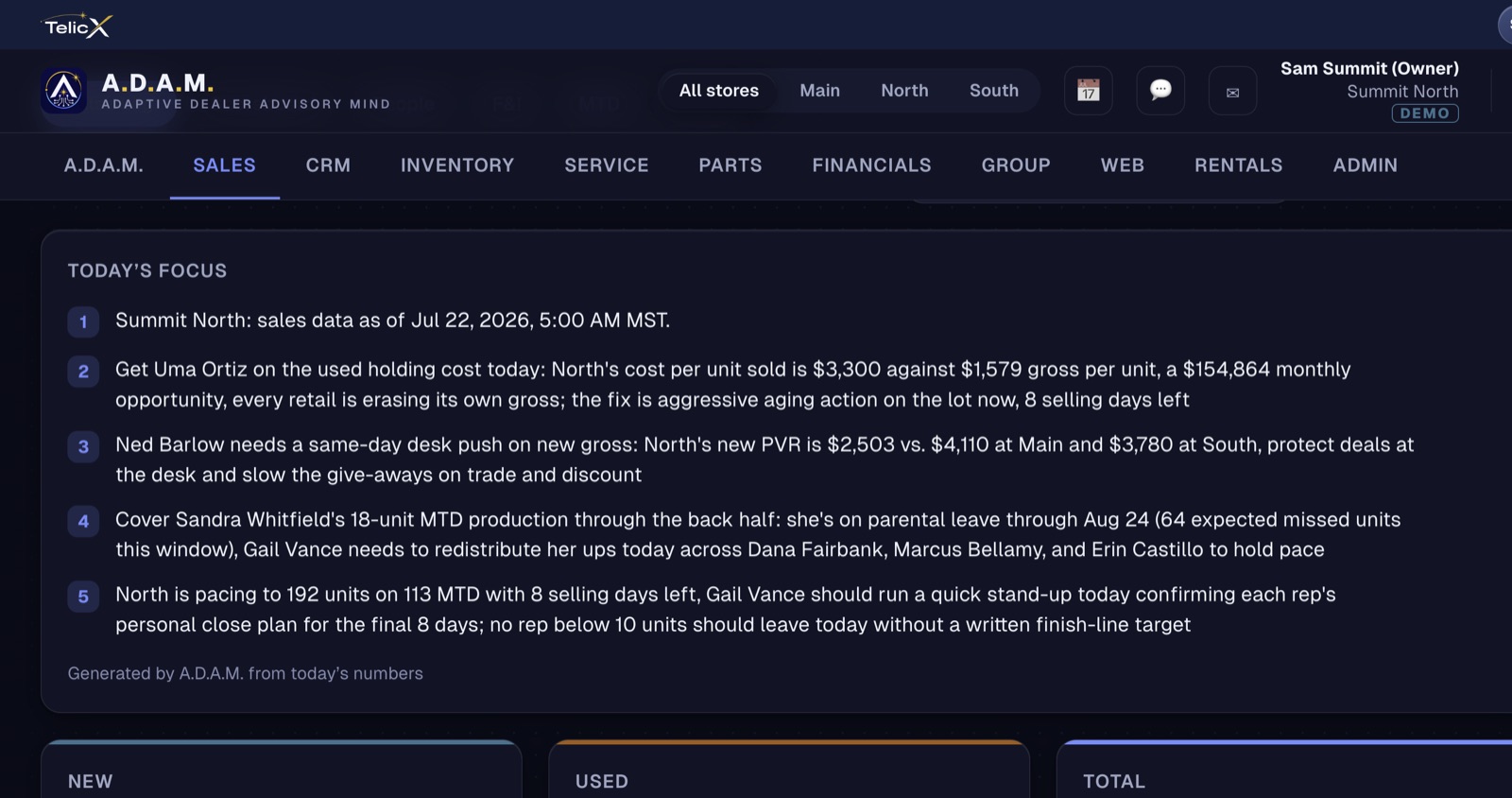
A.D.A.M. reads a rooftop's own performance across the three engines of the business, the variable side, fixed operations, and F and I, and coaches every seat in plain language, from the salesperson to the desk to the general manager. It opens the morning by telling you where the store actually stands. It names what to work first and what it is worth, in real dollars and units. And it reads the departments together, because a number in one part of the store is usually made somewhere else.
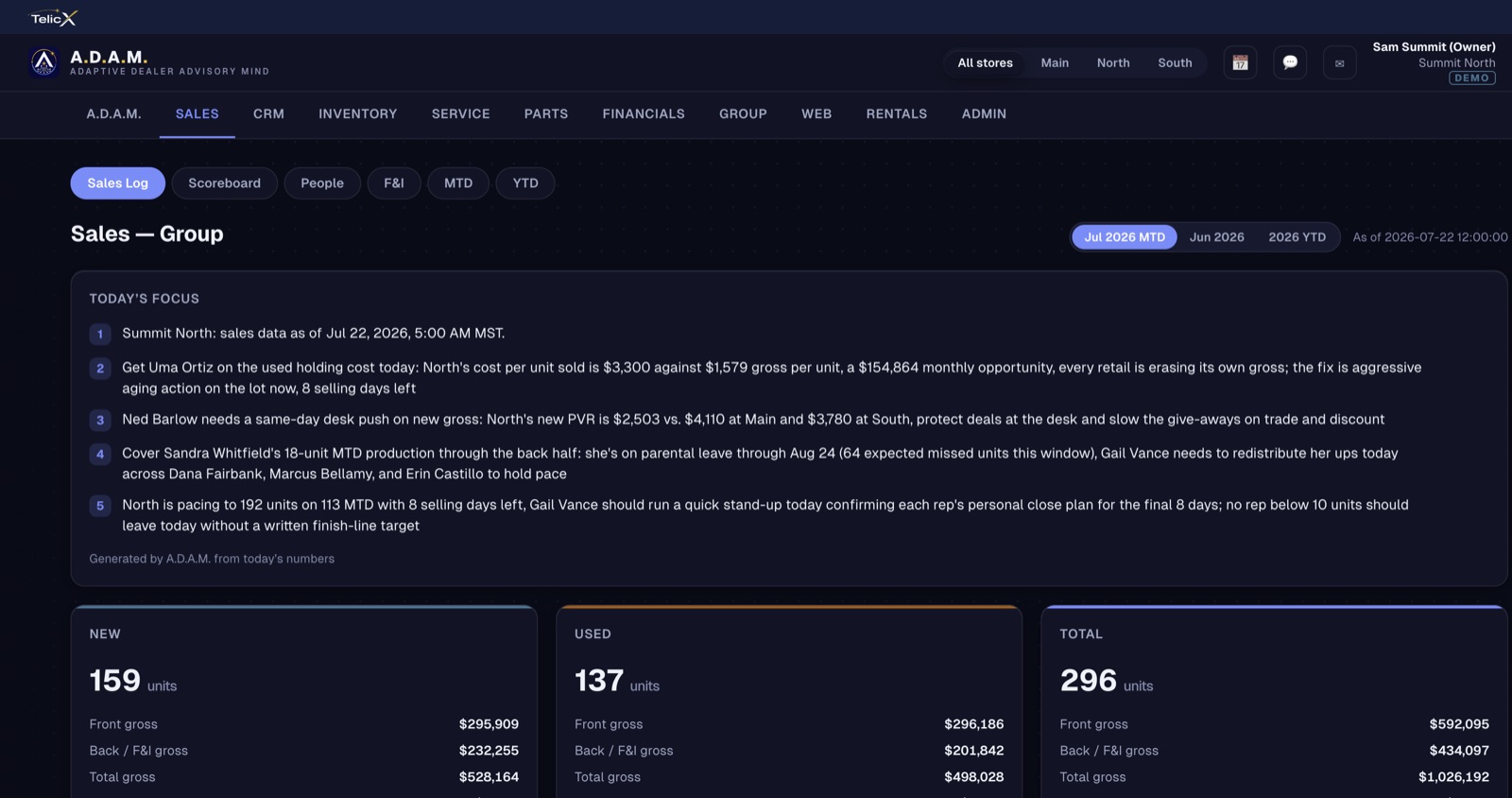
Every figure it speaks is the store's own, computed and verified before it reaches the screen. When it does not have a verified number, it says so. In this business, an advisor that guesses is worse than no advisor at all.
The store is made of people. So A.D.A.M. starts there.
Here is where we went somewhere no dealership software has gone. Stores are built out of people, and A.D.A.M. works the whole arc of them: what they know, what they are paid to do, and how they are reached. Three capabilities, one philosophy.
One. It knows what your people already know. When a store comes aboard, the team comes with it, and A.D.A.M. builds a living inventory of the skills already in the building from your people's own histories. Most dealers know their people's job titles. Almost none know their people's pasts. So picture this: you are weighing a change to a major system in your store, and A.D.A.M. tells you that thirteen of your current employees have hands-on experience with the exact platform you are considering. Perhaps start by talking to them. That is not a hypothetical, that is the capability. The bench is deeper than the org chart says, and A.D.A.M. is how you find out.
Two. It reads the loudest coach in the building: the pay plan. Your pay plan talks to your people every single day, whether it says what you meant it to say or not, and almost nobody audits it. A.D.A.M. reads a plan and shows what it actually rewards, what it actually costs, and where it points people somewhere other than where the store is trying to go. Before you change a plan, you can see what the change will say.
Three. It delivers the same truth differently to different people. Because the same hard truth lands differently on different people, and a coach who has not learned that is not coaching, he is broadcasting. With each team member's consent, and consent governs this capability entirely, A.D.A.M. learns how each person is best reached and shapes how every coaching moment is delivered. It shapes delivery only, never the figures. Hard on the problem, never on the person. How it works is proprietary.
The thread that never drops
Now back to that Monday meeting, because this is the part built for it.
A.D.A.M. carries an internal calendar and communication spine for the store. When leadership sets a directive, A.D.A.M. keeps it alive. It carries the goal to every seat in the language of that seat. It reminds the desk, nudges service, tracks the deadline, and reports the drift back before the drift becomes a miss. The handoff between sales and F and I. The promise time in the service lane. The month-end push that needs every department pulling in the same direction. A.D.A.M. holds the thread on all of it, because it does not get busy, does not get distracted, and delivers the third reminder with the same patience as the first.
That is the trait we are proudest of, and the one no dashboard ever had. A.D.A.M. never stops coaching until the goal is achieved. And then it coaches some more.
And then we built the coach a guardian
A dealer's trust has to be earned every single day, so we built a second system whose only job is protecting the first.
E.V.E., the Eternal Vigilance Engine, watches A.D.A.M. around the clock. She checks every data feed against what the store should be sending and notices when something goes quiet. She walks through the product the way a client would, every few minutes, all night, to prove the doors open and the answers come. She watches the front door for trouble. And when something slips, she heals it, then tells a human what she did. Most days you will never hear from her, and that silence is the point. The machine's quiet is the good news.
A.D.A.M. advises the store. E.V.E. watches A.D.A.M. And yes, we named them that on purpose.
Three promises
Everything above rests on three commitments, and they are not marketing, they are architecture. A.D.A.M. speaks only in a store's own verified figures, or it says it does not know. It proposes and a person approves, so nothing reaches the floor without a human's go. And every rooftop's data is fully isolated. As for how any of it works underneath, we keep the how proprietary.
The questions to ask anyone selling you AI
The AI claims aimed at this industry are about to multiply, so here is the test we would put to anyone, ourselves included. Does it speak your store's verified numbers, or plausible ones? Does anything reach your floor without a human's approval? Does it coach the person, or just flag them? Does it remember Monday's directive on Thursday? And who watches the watcher?
We are comfortable handing you that list because it is the one we built to pass.
The door
The first cohort of rooftops is open now, capped to protect onboarding quality, with a waitlist beyond it. The door is at telicx.com.
This is the first article in a series. In the weeks ahead we will go deeper on the people arc, spend a day inside the life of a single directive, and introduce you properly to the guardian. For now, the whole company fits in three sentences.
The floor does not have a data problem. It has a coaching problem. We built the coach that never clocks out.